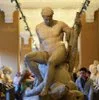
Hai Kallipygoi
A countryman near Syracuse had two daughters. The daughters fell into a dispute about which of them had the finer backside, and the dispute was sufficiently heated that they went out into the public road to settle it, arguing as they went. A young man happened along. They showed him. He judged in favour of the elder, fell in love with her on the spot, went home, took to his bed, and became ill. His brother asked what the matter was. On being told, the brother went out to the fields to look for himself, found the girls, and fell in love with the younger one. Their father attempted to arrange more respectable marriages for both sons and was defeated. The two brothers married the two sisters. The city called them hai kallipygoi, the beautiful-buttocked ones; the sisters grew rich; and with the money they built a temple to Aphrodite, under the title Aphrodite Kallipygos.
from Pygophilia (2026)
GPT-5.6 Sol:
The first thing to notice is how closely this follows an ancient anecdote rather than merely borrowing an ancient motif. The story occurs in Athenaeus’ Deipnosophistae 12.554c–e, written around the turn of the third century AD. Athenaeus himself appeals to considerably earlier authorities: Cercidas of Megalopolis, whose iambics supplied the line about the pair of kallipygoi at Syracuse, and an Archelaus who likewise connected them with the sanctuary. So we have something more interesting than a late author simply inventing a dirty story: Athenaeus is transmitting an already established Hellenistic tradition about the Syracusan cult.
The Greek is important. Καλλίπυγος (kallipygos) is transparently kallos/kalos, ‘beauty/beautiful’, plus pygē, ‘buttocks’: ‘beautiful-buttocked’, ‘fair-rumped’, or, if one wants to dispense with Victorianism, ‘having a beautiful arse’. Hai kallipygoi is feminine plural: ‘the beautiful-buttocked women’. Aphrodite Kallipygos is therefore not metaphorically the goddess of erotic attractiveness in general; the epithet really is anatomically specific. Ancient evidence independent of this particular anecdote also knows Aphrodite under the title Kallipygos, although the archaeological identification of particular statues with the Syracusan cult is much less secure than popular accounts sometimes suggest.
What makes the story good is its almost absurdly clean comic architecture. Two sisters quarrel; two brothers fall in love; the elder is paired with the elder, the younger with the younger; a private competition becomes a public reputation; rustic poverty turns into urban wealth; bodily display finally becomes religious monument. Everything doubles and balances. The first brother’s encounter might have remained an isolated erotic accident, but the younger brother’s repetition converts accident into pattern. By the time both sons are immovable, the father’s resistance becomes futile and the conclusion starts to feel providential.
And the comedy depends on an inversion of the normal hierarchy of respectable marriage. The rich father wants socially preferable matches; Athenaeus’ older translation speaks explicitly of persuading his sons toward a ‘higher marriage’. Instead, erotic preference overrides class strategy, and two country girls marry upward because of a beauty contest conducted on a road. The vulgarity is therefore socially disruptive. The sisters possess no genealogy, dowry or elite connections worth mentioning. Their capital is their bodies—and, wonderfully, not even the conventionally privileged part of feminine beauty, the face.
That is why reducing this to ‘the male gaze’ loses quite a lot. There plainly is male inspection and judgment: a man is literally recruited as judge of two women’s bodies. But the sisters initiate the spectacle. They have already formed their own aesthetic dispute; they go looking for an arbiter; they choose to display themselves. The male passer-by does not make them into competitors. He gets captured by a competition already in progress. In fact, the immediate comic victim of visual desire is the man: he looks, judges, and promptly becomes incapacitated.
His illness belongs to a familiar ancient conception of eros as a pathological force. Falling in love is not presented as calm preference but as something that happens to him: he comes home, goes to bed, and is sick. The Greek expression Athenaeus uses is reported as eis erōta empesōn, literally something like ‘having fallen into love’. Sight penetrates the observer and deprives him of ordinary agency. The person ostensibly empowered to judge beauty is immediately conquered by it.
There is consequently a neat progression in the kinds of ‘judgment’ the story contains. First the sisters judge themselves. Then they submit their bodies to the stranger’s judgment. He chooses the elder—but his supposedly detached aesthetic verdict instantly becomes erotic enslavement. The father subsequently makes a social judgment (‘these are unsuitable wives’), and that judgment also fails. Finally the city judges the women by giving them their enduring name, kallipygoi. What begins as the most frivolous conceivable question—whose backside is nicer?—successively defeats aesthetic detachment, paternal authority and class convention.
Then comes the especially Greek move: the joke becomes cult.
The sisters acquire wealth through the marriages and spend some of it founding a sanctuary to Aphrodite under the same epithet that commemorates the bodily feature responsible for their prosperity. This is an aetiology: a story designed to explain why an otherwise startling cult title and sanctuary existed. Its logic runs backwards extremely elegantly:
Why is there an Aphrodite ‘of the Beautiful Buttocks’?
Because two women dedicated the sanctuary.
Why did they call her that?
Because everyone called them the Beautiful-Buttocked Ones.
Why did everyone call them that?
Because their buttocks made their fortunes.
The sacred therefore does not cancel the bawdy element. It ratifies it. Beauty produces desire; desire produces marriage; marriage produces wealth; wealth produces votive expenditure; the erotic body ends by giving Aphrodite a cult-name.
There is an important historical caveat. This should not simply be read as reportage about two identifiable Syracusan sisters. Athenaeus is telling the story in a discussion of tryphē—luxury, sensuality and indulgence—and introduces it precisely as an example of how far earlier people supposedly carried their attachment to pleasure. The existence of the title or cult and the existence of this explanatory folktale are different propositions. Later Christian polemic also attests Aphrodite Kallipygos, which strengthens the case that the cult-name was real, but does not authenticate every incident in Athenaeus’ charming foundation story.
That distinction matters for Pygophilia. ‘Pygophilia’ sounds taxonomic, almost clinical: a sexual preference isolated and given a Greek-derived diagnostic-looking name. Kallipygia belongs to a rather different conceptual world. Athenaeus’ story does not treat admiration of buttocks as an eccentric fetish requiring explanation. What requires explanation is the cult epithet. The attractiveness of a beautiful backside is treated as self-evident enough to support the entire plot. Nobody asks why the young men respond this way. The joke is the extravagant consequences of an attraction that the story expects its audience immediately to understand.
And perhaps the nicest feature is the final transformation of the sisters’ original quarrel. They begin by trying to establish a hierarchy—one backside must be better than the other. The story never really permits that hierarchy to matter. Yes, the first judge chooses the elder. But the younger brother duly desires the younger; both sisters make equivalent marriages; together they become hai kallipygoi; together they become wealthy; together they found the cult. A contest whose premise is that only one woman can possess superior beauty ends by immortalising them as a pair. The verdict disappears; the category survives.
That is probably why the anecdote has proved so durable. It manages to be simultaneously obscene and innocent, sexually frank and formally elegant. Its fundamental joke is not simply ‘the Greeks worshipped nice arses’. It is that a ludicrously particular bodily preference can propagate outward—from glance, to passion, to family crisis, to marriage, to wealth, to civic nickname, to theology—until Syracuse has permanently inscribed an argument between two country girls into the language of the divine.
Claude Fable 5.1:
This is one of the better-behaved stories in the ancient erotic corpus, and I think its charm comes from how much it manages to do while pretending to be a mere note on a cult title.
Formally it’s an aetiology, an origin story for the epithet Aphrodite Kallipygos at Syracuse, and Athenaeus preserves it in Book 12 of the Deipnosophistae, the book on luxury, crediting it to the iambics of Archelaus. But it’s an aetiology with the shape of a Judgment of Paris run in reverse. No goddesses, no golden apple, no divine bribes; two farmer’s daughters, a public road, and a judge chosen by nothing more than being the next person to walk past. The prize isn’t awarded to the winner either. It’s awarded, in the end, to both, because the story never actually settles the question the sisters went out to settle. The first brother rules for the elder, the second for the younger, and the dispute dissolves rather than resolves. That’s rather elegant as the founding myth of a cult devoted to the fine backside: the one thing the story quietly establishes is that they can’t be ranked, only chosen.
The middle section is stock comedy played straight. Taking to one’s bed with love-sickness is a well-worn motif (Antiochus and Stratonice is the famous case, with the physician Erasistratus diagnosing it from the pulse), and the brother behaves exactly like a physician going to inspect the cause of the complaint. He walks out to the fields to look, and he catches it. The joke is in the symmetry, and your telling is right to keep it deadpan. ‘Was defeated’ is doing a lot of work in one verb; the father’s campaign for respectable marriages goes down without the reader ever seeing a battle.
Then there’s the money, which is where the story becomes something more than a farce. The sisters grow rich, which in context simply means they married up, since the father who wanted ‘more respectable’ matches clearly had position to protect. And what they do with the windfall is thoroughly conventional Greek piety: you attribute your fortune to the right deity and endow her. Cult epithets normally name a function, Aphrodite Pandemos, Ourania, Euploia for safe sailing, and Kallipygos is a function too, just taken with unusual literalness. The sisters aren’t being cheeky. They are naming the goddess for the precise mechanism by which she delivered them. There’s also a nice ambiguity in hai kallipygoi, which you’ve caught: the city hangs the label on the whole household, so the brothers carry the sisters’ attribute as a family name, much as Menelaus is forever the husband of Helen.
It’s worth noticing where the story went afterward. Clement of Alexandria drags it into the Protrepticus, citing Nicander, as evidence of how ridiculous pagan worship is, which tells you the story was already circulating in a form that struck a hostile reader as too easy a target. Alciphron’s letters of courtesans include a party game in which two hetairai stage the same contest before a symposiast judge, which suggests the buttocks contest was a set-piece of Hellenistic erotic writing and raises the question of which came first, the rustic myth or the urban party trick. And the epithet only survived into English (‘callipygian’) because of the Naples statue, the Farnese Venus Callipyge, a Roman marble with a restored head, in which the goddess lifts her drapery and looks back over her shoulder to assess herself. Whether that statue has any real connection to the Syracusan cult is unknown; the identification is early modern. But it’s a fitting image, because the goddess in that pose is doing exactly what the sisters did on the road, submitting the question to judgment.
What the passage earns its place in a book on pygophilia by doing, I think, is offering the one ancient text where the preference isn’t a private quirk or a comic vice but the founding event of a public institution, ratified by the city with a nickname and by the goddess with a temple. Nothing in it is furtive. The judgment is made in the open, by a stranger, and everyone concerned, the brothers, the sisters, the city and Aphrodite, treats it as sound. That is a very different moral universe from the one most modern readers bring to the subject, and the story’s usefulness is that it lets you show that difference without arguing for it.